
What this board answers
Who is actually teaching, how much of the schedule rests on a few people, and what the team costs. Everything comes from the booking platform schedule, not the staff list: active means taught a class in the last 60 days. For owners and Directors; a Location Manager gets a coverage view of their own sites.
How to read it
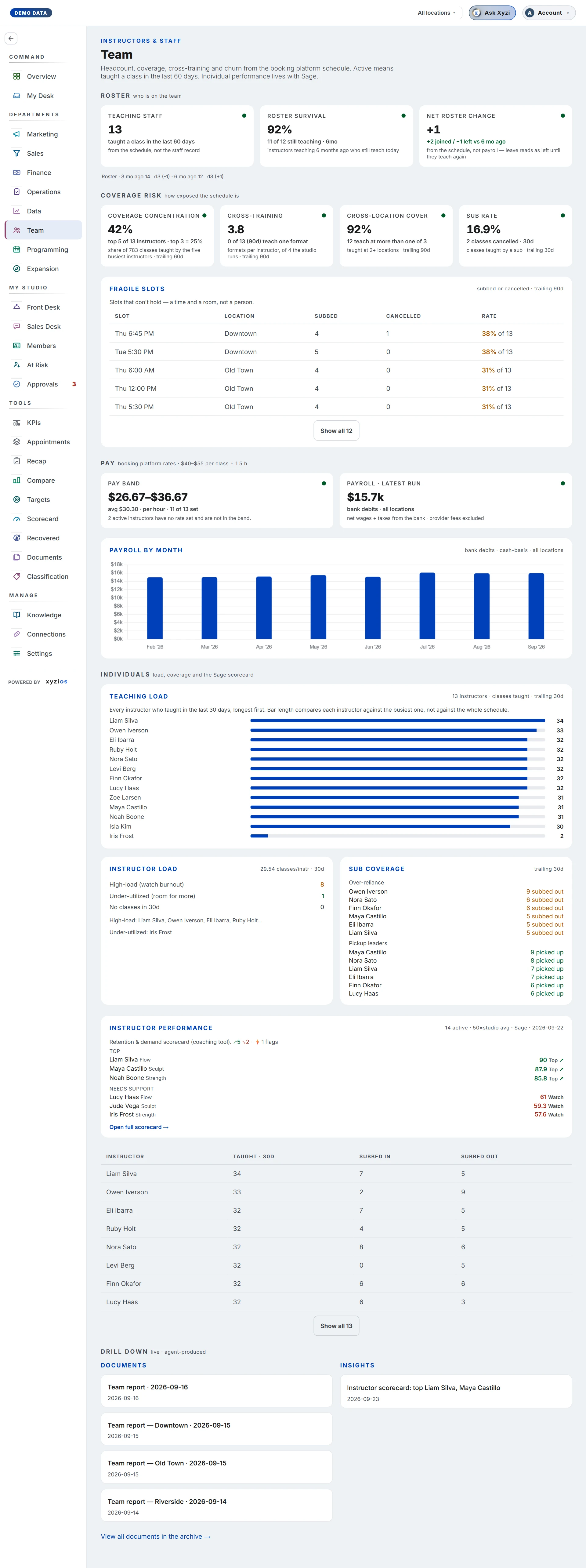
Four sections, in the order the questions come.
Roster: 1Teaching staff (taught in the last 60 days), Roster survival (of the people teaching six months ago, how many still do; a shorter span says so) and Net roster change (joined minus left, with both counts). Leave reads as left until the person teaches again.
Coverage risk: 2Coverage concentration (how much of the teaching the top three and top five carry), 3Cross-training (formats per instructor over 90 days, and how many teach one format), Cross-location cover where there is more than one site, and Sub rate (classes taught by a sub, trailing 30 days, with cancellations). 4Fragile slots lists the recurring slots that keep getting subbed or cancelled over 90 days, with a rate per slot.
Pay: 5Pay band (the range and average of instructor rates from the booking platform, and how many instructors have no rate set) and Payroll where a bank feed or register exists, with Payroll by month. Pay is owner-only; a Director sees it only with the See pay grant in My Team. A studio with neither rates nor a feed sees no Pay section at all.
Individuals: 6Teaching load bars, Instructor load (high-load, under-utilised, no classes in 30 days), 7Sub coverage (Over-reliance and Pickup leaders), 8Instructor performance (the Sage scorecard, top and needs support, with Open full scorecard →) and a per-instructor table of classes taught, subbed in and subbed out. The scorecard judges classes only, by the same rule as Programming: a session counts when its class type is named in the studio’s format map in Studio Setup (or every session, for a studio with no map), never a workshop; amenity slots and unnamed types are left out, and someone whose only sessions are those is not listed. The format beside a name on the scorecard is the one that instructor taught most in the last 90 days, in the studio’s own format names from Studio Setup; the scorecard’s $/class prices each attended visit from the attendee’s membership, and a ClassPass or Wellhub visit at the partner rate set in Studio Setup, on every booking platform. The full scorecard also carries an Adjusted score beside each Score: the same composite with fill and $/class graded against what the studio’s other teachers do in the same kind of slot (format and time of day), a Partner column (the share of a teacher’s attended visits that came through ClassPass or Wellhub, for context only), and a Schedule and basis line per instructor saying what their classes are made of and how much of the adjusted grade came from slot peers, format peers or the whole studio.
Pick a location and the page keeps the same order for that site: sub rate, cancellations, instructor utilisation, classes held, coverage risk, individuals. Instructors are counted by where they taught, so one person can appear at several sites. Headcount, tenure and pay stay on All locations.
A Location Manager sees a different board rather than a thinned one: per site, coverage concentration, cross-training and fragile slots, plus Your coverage, a table of instructors who also teach elsewhere against those who teach only there. No roster, pay, payroll or churn.
Instructors themselves never open this board, and nothing here ranks them to staff; the scorecard is a coaching tool for the owner.
On a location tab, Drill down lists only the documents and insights about that site; the company’s stay on All locations.
What to do here
- Read Coverage concentration and Fragile slots together. A slot that is subbed every third week and sits on one of the top three people is your first hire or cross-train.
- Use Cross-training to pick who learns the next format; the single-format count tells you how thin the bench is.
- Check Over-reliance for who keeps giving classes away and Pickup leaders for who keeps saving them.
- Set missing rates in the booking platform; Pay band says how many instructors are outside the band for want of one.
- Open the full scorecard from Instructor performance before a coaching conversation.
- ✦ Ask Xyzi in the top bar for a figure; ◎ Report for a written summary.
Common questions
Teaching staff is lower than my staff list.
The staff list includes desk staff and people who no longer teach. This board counts only people who taught a non-cancelled class in the last 60 days.
Subbed out shows a dash for everyone.
Your booking platform marks a class as covered but never names who was replaced. Pickups are complete; sub-outs cannot be attributed.
There is no Pay section.
No rates are set in the booking platform and no bank feed or payroll register is connected. It appears when either exists.
Roster survival says measured over four months.
The schedule history does not reach back six months yet, so the card measures what it can and says so.
An instructor appears twice.
They taught at two sites in the window. Each location tab counts them; the company roster counts them once.
Why is a teacher who holds the hardest slots not higher on the scorecard?
Score grades every teacher’s fill and $/class against the whole-studio average, so whoever teaches the 5 pm Barre scores low through no fault of their own. The Adjusted score beside it grades those two against the studio’s own pace in the slots that teacher was given: expected attendance is each class’s seats at the fill the other teachers reach in that format at that time of day, and the teacher’s own classes are never among the peers. A slot needs at least eight classes from at least two other teachers to count; below that the class is graded against the format’s peers, then against the whole studio, and the basis line says how much of the grade fell to each. Retention and engagement are never adjusted, because they are about what happens to a person after they meet the teacher, not about the room. Ranks, tiers and trend follow Score for now; after a month of both, Adjusted becomes the score and the raw one stays in the detail table.
The scorecard calls someone a Reformer teacher who used to read Barre.
The label is the format they taught most in the last 90 days, read through the studio’s own format names, so two spellings of one class count as one format and a class type from years ago no longer outweighs this quarter’s schedule. It says what they teach now, not what they are best at.
Who sees pay?
The owner, and a Director granted See pay in Settings → My Team. Nobody else, on any board.